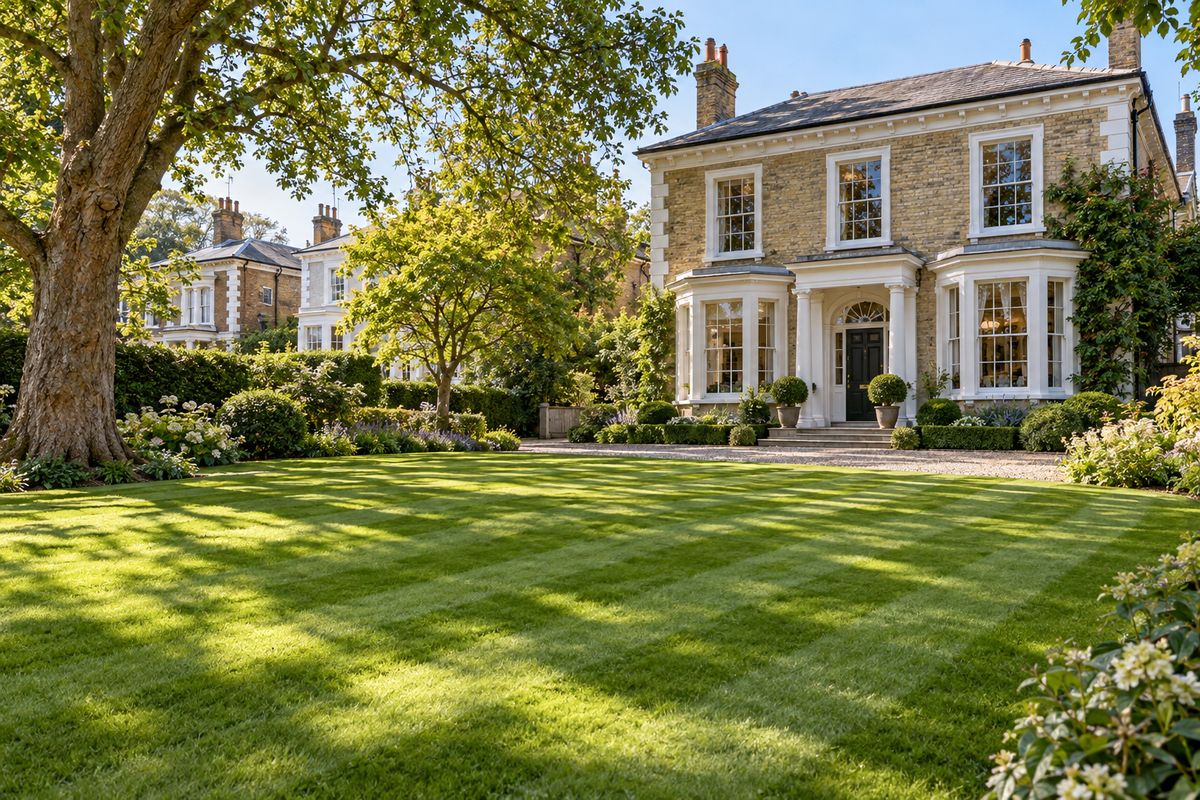
Walmer Castle and its grounds are registered by English Heritage as a Park and Garden of Special Historic Interest, and its gardens are credited to Lady Hester Stanhope. The 2006 Walmer Design Statement describes a parish that runs from the shingle beach and Walmer Green up to Upper Walmer, with wide horizons and the salty tang of the sea in the air. A lawn in Walmer is therefore a coastal lawn, whichever street it is on.
The ground varies with the position. The British Geological Survey memoir records a trial borehole near Walmer Castle where storm-gravel shingle lies on Head Brickearth, which in turn rests on chalk. On Wellington Parade, the design statement says, houses stand on a pebble ridge with the land sloping down into the rear gardens. General guidance: gravel and pebble ground drains fast and dries out in summer, while brickearth holds a little more water. A rear garden that slopes will also shed water from its upper part first, so the top of the lawn browns before the bottom.
The seafront villas on Marine Road and The Beach are described as imposing Victorian and Edwardian houses with high front walls and large shrubs, and some own private walled gardens on the Green itself. Walls and shrubs give shelter from wind, which suits grass, but they also cast shade and trap leaf litter. For lawns like that, scarifying to lift thatch and moss and overseeding in early autumn are the standard pair. Our guide to lawns on East Kent soils covers the soil side.
Away from the sea, the design statement describes the Marke Wood area, where individually designed detached houses and bungalows stand on large plots with the benefit of trees in the park, and the Lord Warden Estate, where a significant number of trees are protected. Big plots under tall trees mean competition for water and light, and roots near the surface make aeration and scarifying a careful job. Some Walmer trees are protected, so check with Dover District Council before pruning or felling.
Archery Square began as a subscription garden called The Green Park, where archery and croquet were played. After 1875 tennis took over, and in 1883 a resident bought the lease to protect the park from building and the Walmer Lawn Tennis and Croquet Club was founded. That heritage sets a high standard, and a fine, closely cut lawn does take steady care: regular scarifying, hollow-tine aeration where the soil compacts, and lawn restoration when a lawn has slipped. Our annual plan spreads this across the year, and the autumn timetable shows the sequence.
What we do in Walmer
- Scarifying Lift moss and thatch so water, air and feed reach the roots.
- Hollow-tine aeration Pull out cores to relieve compaction and let the soil drain and breathe.
- Overseeding Put new grass into thin and worn areas.
- Lawn restoration Scarify, aerate, overseed and feed in one planned visit.
- Lawn maintenance Regular mowing and general lawn work between treatments.
Prices are the same everywhere we work. A typical 100 m² lawn is £135 for a Lawn Refresh, £230 for Lawn Recovery and £325 for Lawn Restoration. Pay for the year and save 10%.
Questions
Does sea air damage lawns in Walmer?
Salt wind can scorch leaf tips on exposed lawns, particularly close to the seafront. Shelter from walls and hedges helps, and a thick, healthy sward recovers better than a thin one. Away from the front the effect is small.
Can a lawn under large protected trees be improved?
Usually yes, to a degree. Shade-tolerant seed, a higher cutting height and removing leaf litter help, and aeration needs care near surface roots. Tree work needs checking with the council first where trees are protected.