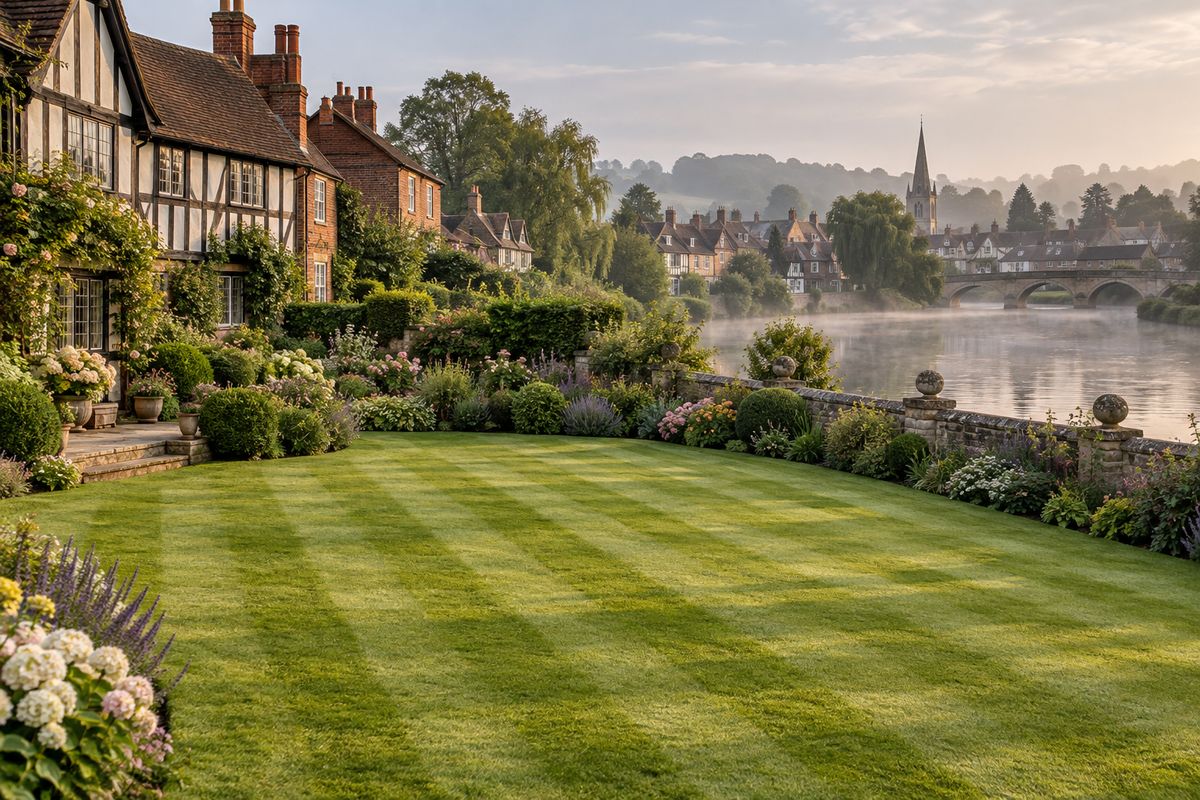
Sandwich lies on the River Stour and is now about 2 miles (3 km) from the sea, after the old Wantsum Channel silted up. Dover District Council's landscape assessment records marine and estuarine alluvium, a heavy clay, on the low ground south east of the town, with seasonally wet deep clay soils above it. West of the town it records Thanet Beds and Head Brickearth, with deep loam to clay soils that are also seasonally wet. So two Sandwich lawns a mile apart can need quite different things.
As general guidance, a clay-based lawn that stays wet in winter compacts easily, grows moss and builds up thatch. That is the case for hollow-tine aeration: it opens the soil so water and air reach the roots, and it is usually followed by overseeding while the ground is still warm. Silty brickearth lawns drain better but can cap over, so a light scarifying in early autumn keeps the surface open. Our guide to lawns on East Kent soils explains how to read your own soil.
The town centre is described as one of the best preserved medieval towns in England, with Flemish-style curved gable ends still visible. The Dutch and French Protestants who settled here in the sixteenth century brought market gardening with them, so growing things in Sandwich has a long history. Dover District Council made an Article 4(2) Direction for the town on 27 January 1998 to protect its character, and the usual conservation-area rules apply, for example to demolishing walls over 1 metre beside a highway. The council also publishes guidance on trees in conservation areas. Lawn care is not building work, but if a tree or wall is part of the problem, check with the council before you change it.
Water is the other local fact. In the 1953 floods the sea covered the whole area around Sandwich, and the fields were afterwards drained and a new river bank built. Low, flat ground beside the Stour tends to have a high water table, and the landscape assessment notes that groundwater on the nearby marshland is controlled by ditches and pumps. General guidance: do not run machinery over saturated ground, and aim the heavy work for the drier spells of spring or early autumn.
Lawn problems in Sandwich usually come down to one of three things: a worn, mossy lawn that needs scarifying and overseeding, a compacted one that needs aeration, or a neglected one that needs lawn restoration. Our annual plan spreads these across the year so each visit happens at the right time, and the autumn timetable shows how the autumn work fits together.
What we do in Sandwich
- Scarifying Lift moss and thatch so water, air and feed reach the roots.
- Hollow-tine aeration Pull out cores to relieve compaction and let the soil drain and breathe.
- Overseeding Put new grass into thin and worn areas.
- Lawn restoration Scarify, aerate, overseed and feed in one planned visit.
- Lawn maintenance Regular mowing and general lawn work between treatments.
Prices are the same everywhere we work. A typical 100 m² lawn is £135 for a Lawn Refresh, £230 for Lawn Recovery and £325 for Lawn Restoration. Pay for the year and save 10%.
Questions
My lawn near the river is boggy every winter. Can aeration fix it?
It can help with compaction, which is a common reason water sits on clay lawns. It cannot lower a high water table. If water is standing on the surface for days even after aeration, the cause is drainage, and that needs a different fix. Send a photo and the size on WhatsApp and we will say which it looks like.
Do conservation-area rules affect lawn work in Sandwich?
Scarifying, aeration and overseeding are not building work. The conservation-area controls cover things like demolishing walls and works to trees. If you are unsure, Dover District Council can tell you what applies to your address.