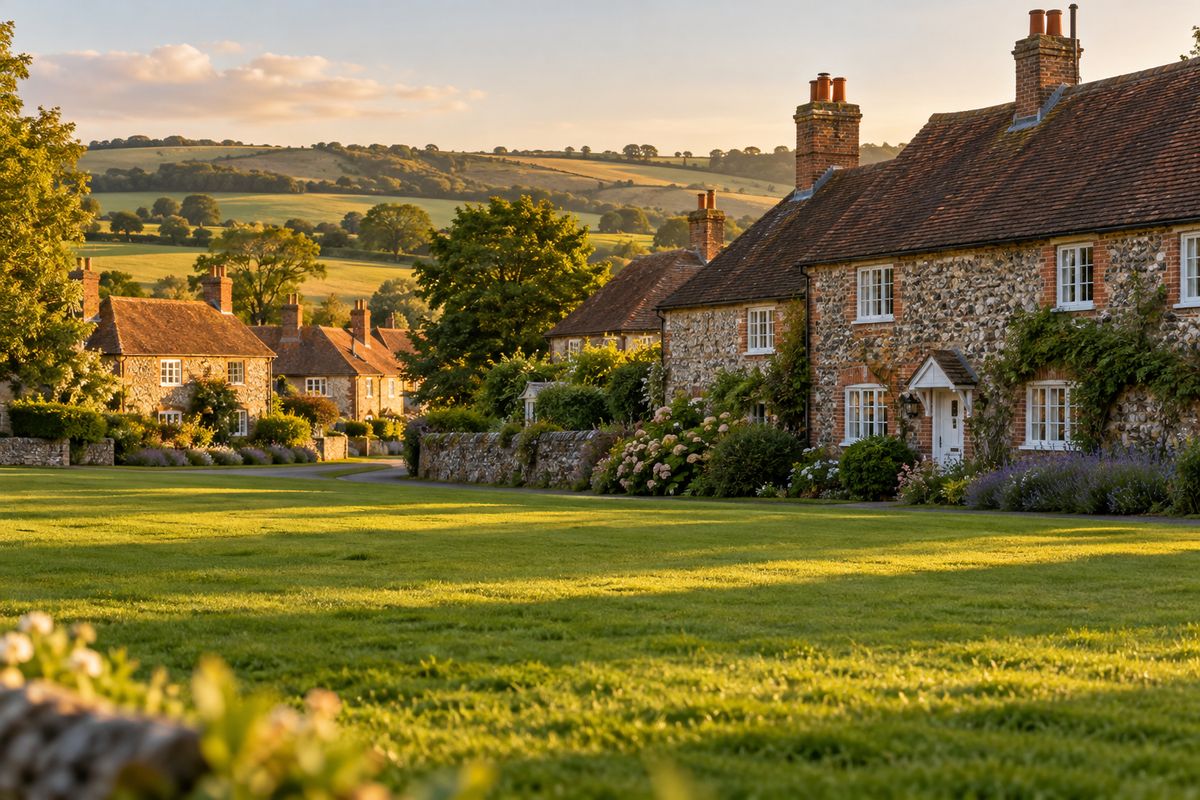
The village's conservation area appraisal states that Great Mongeham lies about 3 km from the east coast on the dip slope of the North Downs, where it merges with the plateau of the North Kent Plain. The underlying geology is chalk overlain with clay and flints. The parish church stands about 30 metres above sea level with land falling away gradually in each direction, and Mongeham Road lies at the bottom of the valley beside a bourne that once linked to a small dock. Higher parts of a village like this tend to be drier, the valley floor wetter.
As general guidance, chalk country soils are free-draining and often stony, and flints near the surface are hard on mower blades and scarifier tines, so it is worth knowing what is under the turf before any scarifying. Clay with flints holds more water, and a lawn on it that sits wet in winter needs hollow-tine aeration. Chalk soils are also typically alkaline, so a lawn that yellows in patches despite feeding may be short of iron rather than nitrogen; a soil test settles it. Our guide to lawns on East Kent soils explains how to read the difference.
Wikipedia's account of the village adds that chalk and lime for Deal Castle in 1538 came from a pit called Pope's Hall, so chalk has shaped the place for centuries. The appraisal lists timber framing, brick, flint and Kent peg tile among the local building materials, with flint walls to the churchyard and brick boundary walls elsewhere. Walls and old houses give shelter but also shade, and a lawn in the lee of a wall may be warmer and drier than one in open ground.
Trees matter here. The appraisal lists beech, holm oak, lime, yew, sycamore, ash, holly, field maple and hawthorn as the characteristic trees, and says all trees in the village's conservation areas are protected, with six weeks' written notice to the council before works. Both conservation areas were designated on 6 November 1970. Under big trees, lawns face shade, root competition and autumn leaf fall. General guidance: rake leaves promptly, keep the mowing height up, and use a shade-tolerant mix when overseeding. Do not prune protected trees without notice.
The appraisal also describes grassy verges, hedgerows and farmland views close to the houses, and 20th-century detached homes in landscaped gardens behind brick walls around Church Close. Gardens here sit next to open country, and lawns beside fields often pick up weed seed from the margins. Where a lawn has lost ground, lawn restoration rebuilds it, and the annual plan spreads the work through the year. The autumn timetable shows the autumn sequence.
What we do in Great Mongeham
- Scarifying Lift moss and thatch so water, air and feed reach the roots.
- Hollow-tine aeration Pull out cores to relieve compaction and let the soil drain and breathe.
- Overseeding Put new grass into thin and worn areas.
- Lawn restoration Scarify, aerate, overseed and feed in one planned visit.
- Lawn maintenance Regular mowing and general lawn work between treatments.
Prices are the same everywhere we work. A typical 100 m² lawn is £135 for a Lawn Refresh, £230 for Lawn Recovery and £325 for Lawn Restoration. Pay for the year and save 10%.
Questions
My lawn in Great Mongeham is full of stones. Does that matter?
Flints near the surface are normal on chalk and clay-with-flints ground. They keep the soil free-draining but dull blades, so they are worth raking out before scarifying and mowing. In a full restoration, fresh topsoil is sometimes added.
Can I cut back a tree that shades my lawn in the conservation area?
Not without telling the council first. Trees in the Great Mongeham conservation areas are protected, and six weeks' written notice is required before works. Lawn work can go ahead around the tree in the meantime.