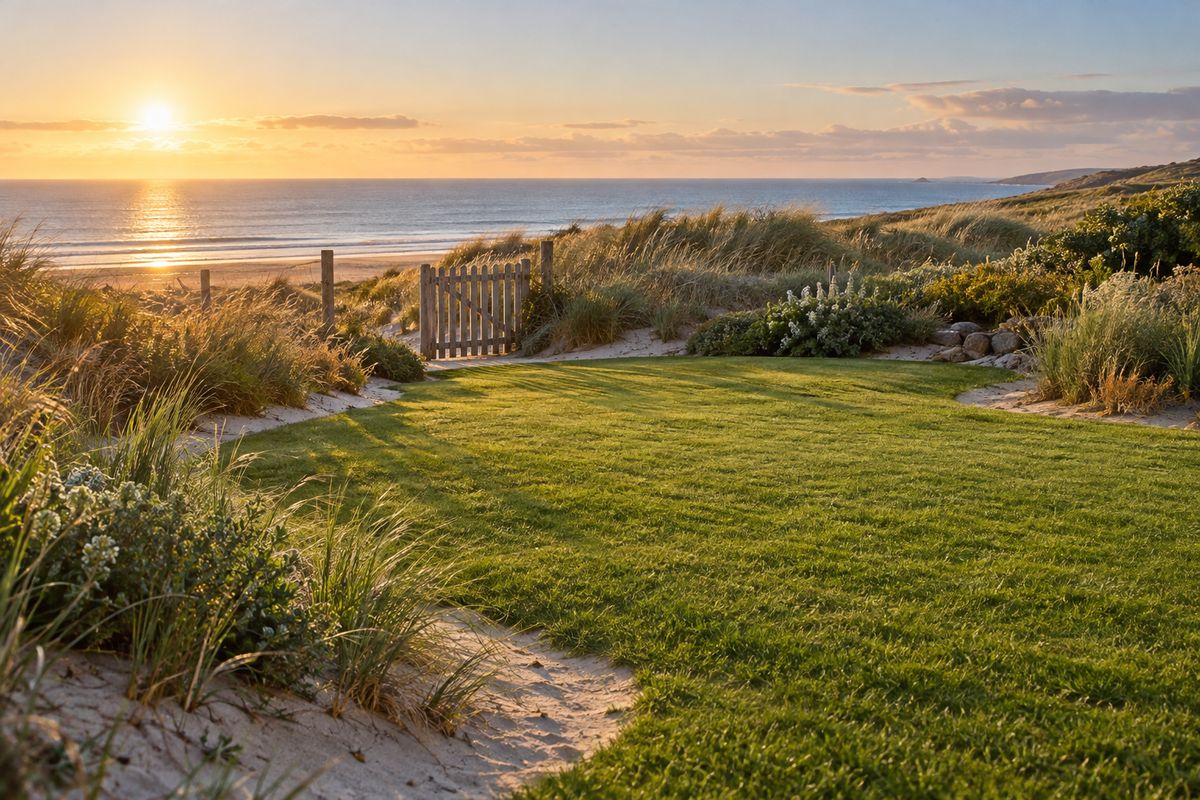
The name Sandwich is Saxon and means sandy place, and nowhere in the parish fits that better than the bay. Dover District Council's landscape assessment describes the soils of the Sandwich Bay area as mainly sandy, deep and well drained. The British Geological Survey memoir adds that the dunes are fine beach sand blown in from the shore at low water, rising above 8 metres in places. Sand like this holds very little water and very few nutrients, which is the main thing to understand about a lawn here.
As general guidance, a lawn on free-draining sand needs feeding little and often rather than in one heavy dose, and it benefits from being cut a little longer in summer so the grass shades its own roots. Compaction is usually less of a problem than on clay, so the emphasis shifts away from hollow-tine aeration and towards controlling thatch with scarifying and thickening thin patches by overseeding. Autumn is the best window because the soil is still warm and the rain returns; the autumn timetable sets this out step by step.
Exposure is the second local fact. The landscape assessment calls the bay an exposed, unenclosed landscape with open views to the sea, almost no trees and coarse dune grasses that the wind blows into drifts. Salt-laden wind dries leaf tips and can scorch grass in the open. General guidance again: hedges and walls that break the wind help a lawn more than any treatment does, and fine, hard-wearing grass mixes cope better than lush ones.
Most of the bay is protected. The Sandwich Bay to Hacklinge Marshes Site of Special Scientific Interest covers 1,790 hectares between Deal and Sandwich, with part of it a national nature reserve, and the landscape assessment describes its dune system as the finest in South East England. If your garden backs onto the dunes or the reserve, tell us so that we can plan the work with that edge in mind.
The estate itself was developed in the early twentieth century as a small, self-contained private estate of large, mostly detached houses in mixed styles, including Arts and Crafts and 1970s designs. Big open-plan plots mean big lawns, and on sand the cost of bad timing, a dry spell right after seeding for example, is high. Where a lawn has thinned badly, lawn restoration is often cleaner than patching, and our annual plan keeps the visits in the right order. For how sand differs from chalk and clay across the area, see lawns on East Kent soils.
What we do in Sandwich Bay
- Scarifying Lift moss and thatch so water, air and feed reach the roots.
- Hollow-tine aeration Pull out cores to relieve compaction and let the soil drain and breathe.
- Overseeding Put new grass into thin and worn areas.
- Lawn restoration Scarify, aerate, overseed and feed in one planned visit.
- Lawn maintenance Regular mowing and general lawn work between treatments.
Prices are the same everywhere we work. A typical 100 m² lawn is £135 for a Lawn Refresh, £230 for Lawn Recovery and £325 for Lawn Restoration. Pay for the year and save 10%.
Questions
Why does my Sandwich Bay lawn turn brown so fast in summer?
Sandy soil holds little water, so grass runs short within days of a dry spell. The lawn is usually dormant rather than dead. A deep, occasional watering is more use than frequent light sprinkling, and feeding and overseeding in autumn thicken the sward so it copes better the next year.
Is overseeding worth it with sea wind drying the ground?
Yes, if the timing is right. Early autumn gives warm soil and returning rain. Sowing on a windy dry day wastes seed, so the work is planned around the forecast and the seedbed is kept moist while it establishes.