What aeration is for
A lawn is a living layer sitting on top of soil, and the grass roots need air and water to move through that soil. When the ground is squashed down, both struggle to get in. Water sits on the surface or runs off, roots stay shallow, and the grass thins out. Moss, which likes damp and shaded conditions where lawn grasses struggle, tends to move in.
The RHS describes the aim of aerating as letting rainwater flow down into the ground more easily. It lists several causes of compaction on its waterlogging page: heavy machinery (especially after building work), regular walking or play, and soil that naturally drains poorly, such as heavy clay. It also warns that walking on a waterlogged lawn makes things worse, because a sticky, glue-like layer of puddled soil can form near the surface.
So aeration is a fix for a specific problem, not a ritual. If your lawn drains well and the grass is thick, you may not need it this year.
How to tell if your lawn is compacted
The RHS pages do not give a single test for compaction, so treat the following as general guidance based on what compacted lawns typically look like, rather than a cited standard.
Look for the pattern, not one symptom. Compaction usually shows up where feet, wheels or play equipment go most, along the shortest route to the washing line or shed, or where a building project left the ground trodden down.
- Puddles that linger for a day or more after ordinary rain.
- Grass that is thin on the worn routes but fine in the corners.
- Moss spreading in the damp, trodden areas.
- A garden fork or screwdriver that goes in easily in the border but meets stiff resistance in the lawn.
- Bare, hard soil showing between the blades where the grass has given up.
Solid spikes: the fork method
Spiking with a garden fork is the simple version. The RHS says to space each set of holes 10-15cm (4-6in) apart and to go as deep as you can, ideally the full depth of the tines. It suggests this for ordinary compaction, and for large lawns it suggests working a different area each autumn rather than tackling everything at once.
Solid tines push the soil aside rather than lifting it out. That is useful, cheap and quick on a small patch. The limit is that on heavy ground the hole can partly close again, and the soil around it can be pressed even tighter by the tine itself. That second point is general guidance rather than something from the RHS pages I read, but it is the reason many people move to hollow tines on stubborn soil.
Hollow tines: lifting soil out
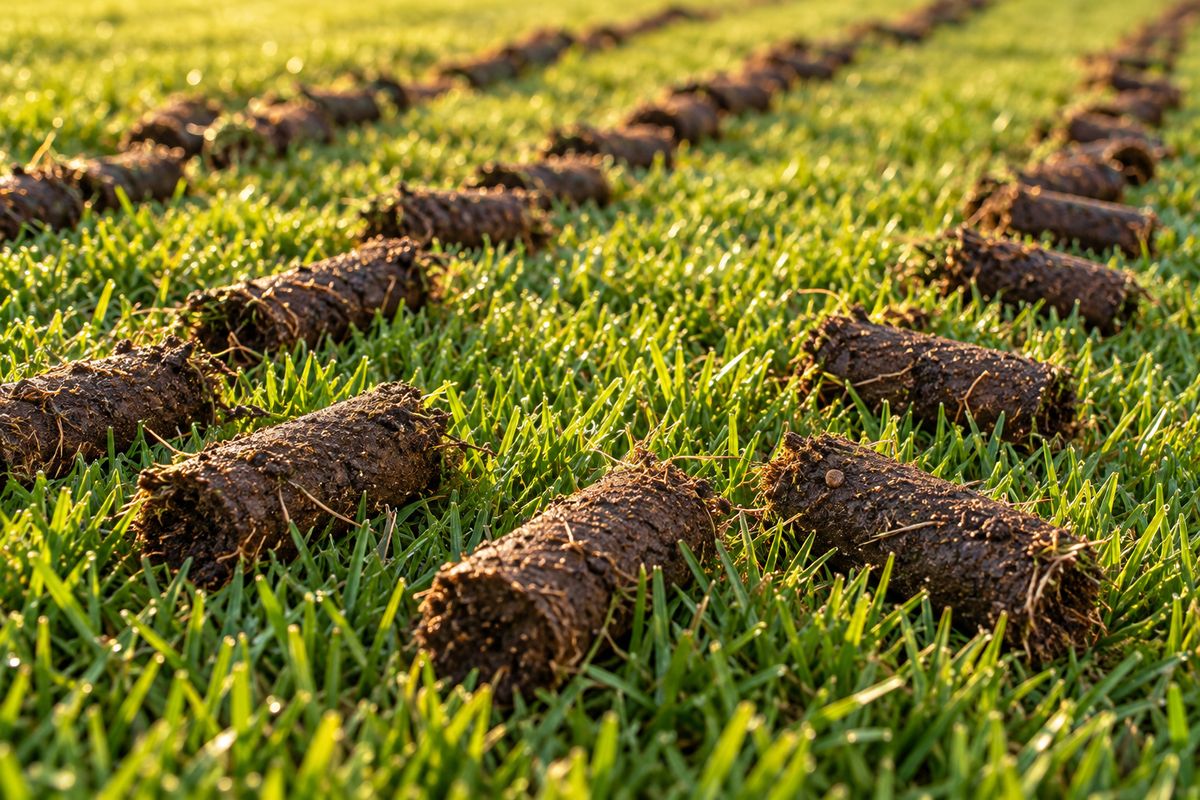
A hollow-tined aerator removes plugs of soil, leaving open holes. The RHS recommends this tool for waterlogged lawns and says holes should ideally be 10-15cm (4-6in) deep. Larger lawns may need a powered aerator, which you can buy or hire.
Because soil is taken out rather than shoved sideways, there is room for the ground to loosen and for a free-draining material to go in afterwards. The RHS suggests hollow tines for clay or waterlogged soil, and mentions hollow-tine aeration as the way to relieve compaction and improve drainage on moss-prone lawns.
The two methods are not in competition. The practical difference is how much improvement you need. Light wear on well-drained soil: a fork or a lighter aeration may be enough. Heavy ground, standing water, or a lawn that has been driven over: hollow tines are the stronger tool.
How soil type changes the choice
The RHS soil types page says clay soils drain slowly, are easily compacted when trodden on while wet, and take longer to warm up in spring than sandy soils. That makes them the main candidates for hollow tines. Sandy soils drain quickly after rain, so they are less likely to suffer from waterlogging and may need aeration less often.
Light soil can still have problems. The RHS lists compaction, light soil and a thick accumulation of thatch among the factors that make a lawn more prone to dry patch, where water stops soaking in. It recommends avoiding compaction and aerating with a fork or hollow-tine cultivator. If your lawn is spongy as well as hard, the thatch needs attention too: see our guide to how much thatch is too much.
Soil varies from garden to garden, even on the same road. Our guide to sandy, chalk and clay soils in East Kent explains how to check yours.
When to do it
The RHS puts the key autumn tasks, aerating among them, in September or October, and says that if a lawn is prone to waterlogging you should spike it every few years in autumn. It also says to wait until standing water has drained before aerating, or to sweep it off small areas into the borders first.
Its waterlogging page adds that late autumn and winter are the best times to take action on waterlogged lawns. Taken together, the sensible reading is autumn, on soil that is damp but not saturated. Avoid aerating in frost, in deep drought, or when the ground is a bog.
If you also plan to scarify or overseed, aeration usually slots into the same autumn window. Our autumn lawn restoration timetable shows one way to order the jobs.
What to do with the cores
The RHS says to sweep up the soil plugs and then rake top dressing into the holes. The cores are not a feature, and leaving them to crumble across the lawn can smother the grass and leave a messy surface. Add them to a compost heap or a border.
For top dressing, the RHS gives a rate of 2-3kg per sq m (4-7lb per 10 sq ft), roughly one shovelful each time, and a mix of three parts sandy loam, six parts sharp sand and one part well-rotted compost or soil improver. It says to apply less if a lot is left on the surface and slightly more if it disappears very quickly. On a waterlogged lawn it suggests a free-draining dressing such as horticultural sand brushed into the holes.
What to do afterwards
Once the holes are filled, the lawn is in a good state to take seed. The RHS lists an autumn feed after scarifying and aerating, if the grass is growing poorly, and notes that autumn feeds are high in potassium and phosphorus rather than nitrogen. It specifically warns against using leftover summer feed, which is high in nitrogen and encourages disease-prone growth at this time of year.
Thin areas can then be sown. Our guide to overseeding step by step covers rates and aftercare. If you would rather have the work done, we offer hollow-tine aeration as a standalone service and alongside overseeding.
How often
The RHS says most lawns benefit from aerating every two to three years, and that on clay or waterlogged soil a hollow-tined aerator is used every three to four years. Those are the ranges to start from. A heavily used lawn, or one that floods every winter, may justify the shorter interval. A lawn that is draining well and growing thick does not need to be treated on a calendar for its own sake.
Questions
Is spiking with a fork enough?
For small areas and light compaction, yes. The RHS recommends holes 10-15cm (4-6in) apart, as deep as you can go. On heavy or waterlogged ground the RHS points to a hollow-tined aerator, which removes plugs of soil.
Should I leave the cores on the lawn?
The RHS says to sweep them up and rake top dressing into the holes. Compost them or use them in a border.
When is the best time to aerate?
The RHS places aerating in the autumn jobs, best done in September or October, and says to wait until standing water has drained. See our autumn timetable for the order of jobs.
Do I need to aerate every year?
Not usually. The RHS suggests every two to three years for most lawns and every three to four years with a hollow-tined aerator on clay or waterlogged soil.
Sources
- RHS: Lawn care in autumn, fork spacing, frequency, top dressing rate and mix, autumn timing
- RHS: Waterlogged lawns, causes of compaction, hollow-tine depth, draining first, free-draining dressing
- RHS: Lawns, October jobs, autumn feed after aerating, avoid summer feed
- RHS: Soil types, clay and sandy soil behaviour
- RHS: Moss in lawns, compaction and moss, hollow-tine aeration
- RHS: Lawns, dry patch, light soil, compaction and thatch