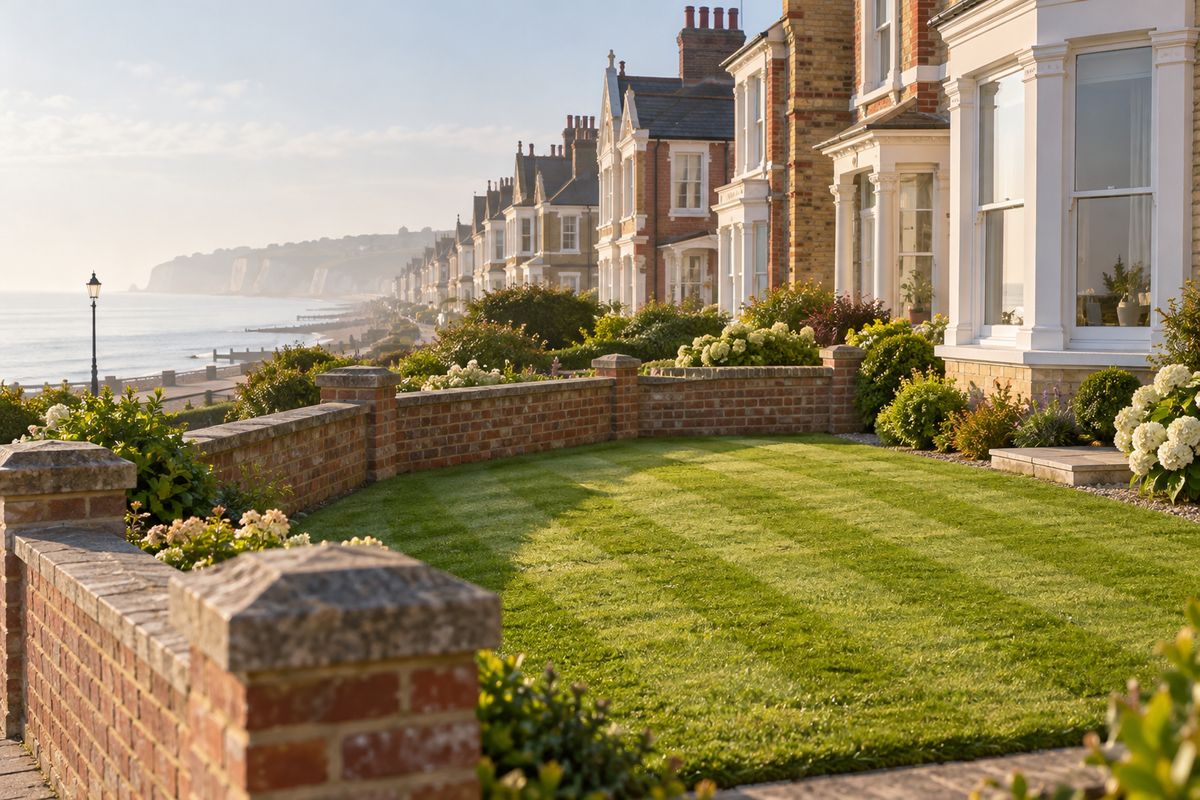
Broadstairs has the chalk right under its feet. Wikipedia notes that in 1538 a road was cut into the "rough chalk ground" on which the town is built, and the town lies above a harbour with cliffs either side. Chalk is alkaline and free-draining, so general guidance for a Broadstairs lawn is little and often: modest feeding, a slightly higher cut, and top-dressing with a loamy mix rather than leaving thin soil to bake. Chalk lawns also tend to run low on nutrients such as iron, which shows as pale, yellowing grass, so a feed matters more than extra watering. Our guide to lawns on East Kent soils goes through how chalk, brickearth and clay behave differently.
The coast here is a string of seven bays, from Dumpton Gap in the south to Botany Bay in the north, and North Foreland, a chalk headland that presents a bold cliff to the sea, forms the eastern edge of the Isle of Thanet. Gardens near the seafront are open to wind from the water. As general guidance, an exposed lawn loses moisture faster, so it benefits from hollow-tine aeration in autumn to let rain reach the roots, and from patching bare gaps with overseeding before weeds move in.
The Isle of Thanet has long been farmed. Wikipedia says its soil and equable climate "have always encouraged arable farming", and brickearth lies in many of the shallow chalk valleys, so garden soil can change from one road to the next. Pierremont Park, the town's main park, shares its name with Pierremont Hall, built in 1785, and the older parts of town tend to have more established gardens. Older lawns in general carry more thatch, the layer of dead stems and roots at the base of the grass, and scarifying is the usual fix.
Late-Victorian Broadstairs also filled with convalescent homes for children, drawn by the sea air. The sea air is still there, and lawns neglected for a few seasons can look tired by September. For those, lawn restoration is the thorough option. For a lawn that is basically sound, our annual plan keeps it ticking over through the year. We work in Broadstairs and the surrounding Thanet coast; send your postcode and a photo of the lawn for a view on what it needs. Autumn is the best window for most of the work here, because the soil is still warm and the autumn rain helps new seed settle in before winter.
What we do in Broadstairs
- Scarifying Lift moss and thatch so water, air and feed reach the roots.
- Hollow-tine aeration Pull out cores to relieve compaction and let the soil drain and breathe.
- Overseeding Put new grass into thin and worn areas.
- Lawn restoration Scarify, aerate, overseed and feed in one planned visit.
- Lawn maintenance Regular mowing and general lawn work between treatments.
Prices are the same everywhere we work. A typical 100 m² lawn is £135 for a Lawn Refresh, £230 for Lawn Recovery and £325 for Lawn Restoration. Pay for the year and save 10%.
Questions
Is sea air bad for lawns in Broadstairs?
Wind off the sea can dry a lawn faster than one in a sheltered inland garden. As general guidance, mow a little higher, aerate in autumn and water deeply and rarely in a dry spell rather than a little every day.
My Broadstairs soil looks pale and thin. What should I do?
Pale, thin soil often means chalk close to the surface. Chalk drains freely, so top-dress with a loamy mix and feed lightly but regularly. Our East Kent soils guide has more.
Can you work on a lawn near the seafront?
Yes. We cover Broadstairs, including the bays and cliff-top streets. Send an address and a photo so we can advise.